“To keep every cog and wheel is the first precaution of intelligent tinkering.”— Aldo Leopold, Round River
Introduction
Imagine standing on two neighboring properties.
One is a neatly mowed pasture with scattered trees and a small food plot tucked into one corner. The other contains mature oaks, native grasses, brushy fence rows, wildflowers, a seasonal creek, and patches of young woodland.
Both properties provide habitat.
But they don't provide the same habitat.
The difference isn't simply the number of acres or whether one property has more trees than the other. It's the diversity of resources available to wildlife and how those resources are arranged across the landscape.
Habitat is one of the most frequently used words in conservation, yet it is also one of the most misunderstood. Many people picture habitat as a place—a forest, a prairie, or a pond. In reality, habitat is much more than a location. It is the combination of food, water, cover, and space that allows wildlife to survive and complete its life cycle.
Understanding those four essentials is the foundation of good stewardship.
Whether your goal is producing healthier deer, restoring bobwhite quail, attracting monarch butterflies, enjoying more songbirds around your home, or simply leaving your property better than you found it, every successful habitat project begins with understanding these principles.
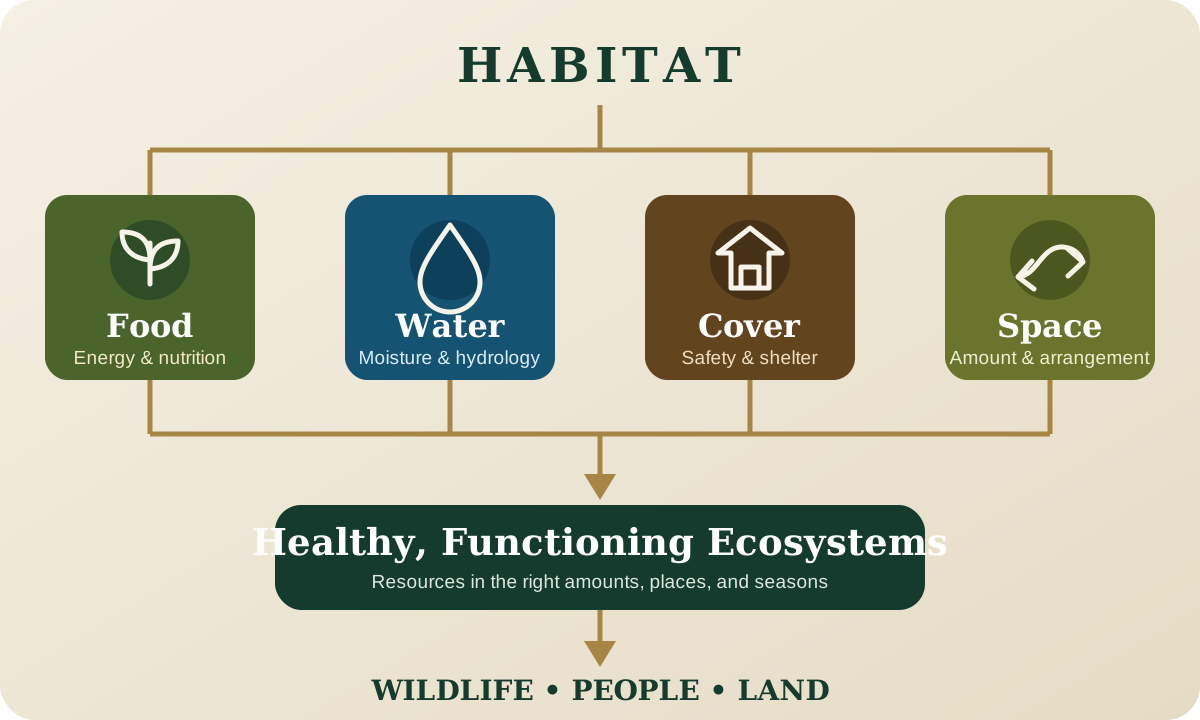
A healthy habitat is built when Food, Water, Cover, and Space work together to support resilient ecosystems.
Stewardship Begins With Goals
One of the biggest misconceptions in habitat management is that there is only one "correct" way to manage land.
There isn't.
Every property owner has different goals.
Some dream of hearing a covey of bobwhite whistle from the edge of an old field. Others hope to improve hunting opportunities for white-tailed deer or wild turkeys. Some want to watch hummingbirds visit native flowers outside the kitchen window. Others simply want healthier woods, cleaner water, or a place where their children and grandchildren can enjoy the outdoors.
Those goals are all valid.
Good stewardship isn't about telling landowners what they should want from their property. Instead, it provides the knowledge needed to make informed decisions while understanding the tradeoffs that come with every management action.
A five-acre food plot for deer is not "wrong." It may be exactly the right decision for that property and those goals. At the same time, recognizing how that decision affects other habitat features helps you make even better choices in the future.
The purpose of habitat management is not perfection.
The purpose is progress.
What Is Habitat?
Habitat is one of the most common words used in wildlife conservation, yet it is often one of the most misunderstood.
Ask ten people to describe habitat, and you'll likely hear answers like "the woods," "a pond," "a prairie," or simply "where an animal lives." While those answers aren't wrong, they only tell part of the story.
A mature oak forest may provide excellent habitat for one species while offering very little for another. Likewise, a field that appears empty to us may be one of the most productive habitats on the property for pollinators, ground-nesting birds, rabbits, and countless other forms of wildlife.
Habitat is not defined by what we see. It is defined by what the organisms living there need.
In its simplest form, habitat is the combination of resources and environmental conditions that allow a species to survive, grow, reproduce, and complete its life cycle. Every animal experiences the landscape differently. A white-tailed deer, a northern bobwhite, a monarch butterfly, and an eastern cottontail may all use the same property, but each relies on different resources and interacts with that landscape in unique ways.
Although every species has specific requirements, wildlife managers commonly organize terrestrial habitat around four broad components:
Food — The energy needed to survive, grow, and reproduce.
Water — Reliable sources of moisture and healthy hydrologic systems.
Cover — Protection from predators, weather, and disturbance, as well as places to nest, rest, and raise young.
Space — Enough connected habitat to meet daily and seasonal needs.
When these four components work together, habitat becomes far more than the sum of its parts.
Habitat Is Dynamic
One of the biggest misconceptions about habitat is that it is permanent.
It isn't.
Habitats are constantly changing.
A hay field becomes a young forest if left unmanaged. A mature woodland can be reshaped overnight by a tornado. A prescribed burn may blacken a prairie one week and be covered in wildflowers the next growing season. Trees mature, streams change course, invasive species arrive, and wildlife populations respond to those changes.
The needs of wildlife change as well.
A wild turkey may spend the spring nesting in native grasses, raise poults in open areas rich with insects during the summer, and roost in mature hardwoods throughout the year. A monarch butterfly depends on milkweed to reproduce but requires a variety of nectar-producing flowers throughout its migration. Even white-tailed deer shift where they feed, bed, and travel as food availability and hunting pressure change throughout the seasons.
Healthy habitat is not something we build once and forget. It is something we observe, manage, and continually adapt as the landscape changes.
Habitat Exists at Every Scale
When people hear the phrase "habitat management," they often picture large farms or expansive hunting properties.
In reality, habitat exists everywhere.
A single oak tree in a neighborhood may provide food for squirrels, shade for insects, and nesting opportunities for birds.
A brush pile along the edge of a field can become shelter for rabbits, wrens, box turtles, and countless invertebrates.
A small pollinator garden may support monarch butterflies while also providing nectar for native bees, hummingbirds, and other beneficial insects.
Likewise, a thousand-acre property is not automatically good habitat simply because it is large. Size is important for some species, but habitat quality, diversity, and connectivity often matter just as much.
Whether you manage a suburban backyard, a family farm, or several hundred acres of timber, the same ecological principles apply. The scale changes—but the fundamentals remain the same.
Habitat Is About Relationships
Perhaps the most important lesson in habitat management is that no feature exists in isolation.
A stand of native grasses isn't simply "deer bedding."
A brush pile isn't only "rabbit cover."
An oak tree isn't just "acorns for deer."
Each of these features supports an entire community of organisms, many of which never receive the same attention as game species. Pollinators rely on flowering plants. Songbirds depend on insects that develop on native vegetation. Small mammals become prey for hawks and owls. Fungi and soil organisms recycle nutrients that allow plants to grow.
Every habitat improvement sends ripples through the ecosystem.
That's why effective habitat management isn't about asking,
"How do I help this one species?"
It's about asking,
"How can I improve the health of this ecosystem while working toward my goals as a landowner?"
When we begin thinking that way, we stop seeing habitat as individual pieces scattered across the landscape and start seeing how those pieces fit together. A healthy ecosystem is rarely built around one feature—it develops through the interaction of many different habitat components, each supporting wildlife in its own way.
Understanding those relationships is what transforms habitat management from a collection of projects into thoughtful stewardship. Whether your goal is improving hunting opportunities, attracting pollinators, restoring native vegetation, or simply enjoying more wildlife on your property, the same foundation applies.
Now that we've explored what habitat is—and what it isn't—let's take a closer look at the four building blocks that every healthy terrestrial habitat depends on: food, water, cover, and space.
Food
More Than Something to Eat
When most people think about improving wildlife habitat, food is usually the first thing that comes to mind. Food plots, feeders, fruit trees, and mast-producing oaks are all common management practices, and each can play an important role in supporting wildlife. But food is much more than what we intentionally provide. Plants capture solar energy, while insects, fungi, and countless other organisms transfer energy and recycle nutrients through the food web.
Food is the fuel that powers every ecosystem. It allows wildlife to grow, reproduce, survive harsh seasons, and raise the next generation. The challenge is that food availability changes throughout the year. Acorns may be abundant in the fall, tender browse is most nutritious in the spring, berries ripen throughout the summer, and many songbirds rely heavily on insects while raising their young before switching to seeds later in the year. No single food source can meet every need for every species throughout the year.
A property with diverse plant communities can provide a more reliable food supply than one dominated by a single crop or vegetation type. Native grasses produce seed, wildflowers provide nectar and pollen, shrubs offer browse and berries, hardwoods produce mast, and insects become an essential food source for countless birds, reptiles, amphibians, and mammals. When those resources are appropriate to the site and the species present, diversity can improve resilience as seasons and food availability change.
For landowners, this doesn't mean every property needs to be converted into a native prairie or unmanaged woodland. Agricultural fields, orchards, food plots, hayfields, and gardens all have a place on the landscape. The goal is to understand how those features fit into the broader habitat. A well-designed food plot surrounded by quality cover may provide tremendous value for deer and wild turkeys while also creating feeding opportunities for songbirds, rabbits, pollinators, and many other species along its edges.
One of the most common misconceptions in habitat management is that more food automatically means better habitat. In reality, food is only one of four habitat essentials. A property with abundant food but little cover may see wildlife feeding there only briefly before they move elsewhere to rest, nest, or escape predators. Likewise, excellent food sources are of limited value if they are isolated from water or connected habitat.
The better question isn't simply,
"Do I have enough food?"
It's,
"Am I providing a variety of food sources that work together with water, cover, and space throughout the year?"
Water
More Than a Place to Drink
Water is one of the most fundamental requirements for life, but its role in wildlife habitat extends far beyond simply providing animals with a place to drink. Every rainfall begins a journey across the landscape, and the path that water takes influences everything from plant growth and soil health to erosion, wildlife movement, and the overall health of an ecosystem.
When most people think about water, they picture ponds, lakes, streams, or rivers. While these are certainly important, many wildlife species depend on much smaller and less obvious sources of water. Springs, seeps, seasonal wetlands, ephemeral pools, roadside ditches, and even morning dew can provide critical moisture at different times of the year. Some animals rarely drink standing water at all, obtaining much of the moisture they need from insects, fruits, or succulent vegetation.
Water Shapes the Landscape
Water doesn't simply exist on the landscape—it actively shapes it.
Every time it rains, some water infiltrates into the soil, where it may replenish soil moisture or groundwater. Some is absorbed by roots and later returned to the atmosphere through transpiration; some evaporates directly; and some fills wetlands, ponds, and streams. Water that flows across the surface can carry sediment, organic matter, and nutrients with it.
The way water moves across a property has a tremendous influence on habitat quality.
Healthy, well-structured soils with adequate organic matter generally allow more rainfall to soak into the ground, reducing runoff while storing moisture that plants can use after a storm has passed. In contrast, compacted soils and restrictive layers can reduce infiltration, causing more water to move across the surface. That runoff may carry valuable topsoil and nutrients into nearby waterways while leaving less water available in the soil.
Fortunately, many habitat improvements also improve the way water moves through the landscape. Healthy vegetation slows runoff, root systems help create pathways for water to enter the soil, and riparian buffers filter sediment before it reaches streams and ponds. These practices not only benefit wildlife but also strengthen the long-term health of the land itself.
We'll explore these topics in much greater detail in future articles on soil health, riparian habitats, and aquatic ecosystems. For now, the important takeaway is simple:
The way water moves across your property has a profound influence on the quality of your habitat.
Land and Water Are Connected
Although this article focuses primarily on terrestrial habitat, it is impossible to separate the health of the land from the health of its water.
Healthy forests can protect streams by stabilizing soil and reducing erosion. Vegetated buffers can slow runoff and trap sediment before it reaches ponds, wetlands, and streams. Many wetlands store floodwater and moderate streamflow, while some recharge groundwater and others primarily receive groundwater; those functions depend on soils, geology, topography, and hydrology. Wetlands also provide important habitat for terrestrial and aquatic wildlife. Healthy aquatic systems, in turn, influence surrounding landscapes by supporting plant communities and providing movement corridors for many species.
Rather than thinking of land and water as separate systems, it is more helpful to view them as parts of the same living landscape. Decisions made in one often influence the other, sometimes in ways that are not immediately obvious.
Cover
More Than a Place to Hide
When many people hear the word cover, they picture a brush pile or a dense thicket where wildlife can hide from predators. While those features certainly provide cover, the concept is much broader than simply having a place to escape danger.
Cover is the part of a habitat that allows wildlife to carry out life's most important activities safely. It provides protection from predators, shelter from harsh weather, places to nest and raise young, areas to rest during the day, and refuge during the changing seasons. Without adequate cover, even a property rich in food and water may support surprisingly little wildlife.
One of the most important things to understand is that cover serves different purposes throughout the year. A habitat feature that provides excellent nesting cover in the spring may offer very little protection during the winter. Likewise, mature timber that serves as valuable thermal cover on a cold January morning may provide little brood habitat for young quail or turkeys during the summer.
Quality habitat contains a diversity of cover types, each serving a different purpose throughout the year.
The Many Forms of Cover
Not all cover looks the same, and not every species uses it the same way.
Different forms of cover include:
Thermal Cover — Protection from extreme heat, cold, wind, or snow.
Escape Cover — Dense vegetation or structure that allows wildlife to avoid predators.
Nesting Cover — Areas suitable for laying eggs or giving birth.
Brood-Rearing Cover — Habitat that provides food, protection, and mobility for young wildlife.
Roosting Cover — Trees and vegetation used by birds while resting.
Loafing Cover — Safe places where wildlife can rest during the day.
Winter Cover — Areas that provide protection during harsh weather.
Many habitat features provide several of these functions at the same time.
A cedar thicket, for example, may provide winter shelter for deer, escape cover for rabbits, roosting opportunities for birds, and protection for countless smaller animals.
Structure Matters
One of the greatest strengths of healthy habitat is structural diversity.
Rather than consisting of a single layer of vegetation, productive habitats contain multiple layers that support different wildlife.
Imagine standing in a healthy woodland.
Above you, mature trees form the canopy.
Below that, young trees and shrubs create the understory.
Native grasses and wildflowers fill openings where sunlight reaches the forest floor.
Fallen logs slowly decompose, returning nutrients to the soil while providing homes for fungi, insects, salamanders, reptiles, and small mammals.
Every layer contributes something different.
Some species spend most of their lives high in the canopy.
Others rarely leave the leaf litter.
Many move between several layers throughout the day or across the seasons.
Greater structural diversity generally creates a broader range of ecological niches, although the most useful structure depends on the species and natural community being managed.
"Messy" Can Be Beautiful
One of the most common misconceptions in habitat management is that a healthy property should always look clean and manicured.
Nature rarely works that way.
A fallen tree isn't necessarily a problem to remove.
A brush pile isn't simply yard waste.
Standing dead trees, commonly called snags, may appear lifeless, yet they provide nesting cavities for woodpeckers, bluebirds, owls, bats, and many other wildlife species. Downed logs retain moisture, support fungi and insects, and provide shelter for salamanders, reptiles, and small mammals. Brush piles become valuable escape cover for rabbits, wrens, towhees, and countless other species.
That doesn't mean every fallen tree should remain where it falls. Safety, access, aesthetics, and management objectives all matter. However, understanding the ecological value of these natural features allows landowners to make informed decisions instead of automatically viewing every "messy" area as something that needs to be cleaned up.
Space
More Than Acres
One of the biggest misconceptions in wildlife management is that more acres automatically mean better habitat.
While the size of a property certainly matters for some species, acreage alone does not describe habitat quality. The amount of suitable habitat and the way it is arranged both matter, and their relative importance varies by species and landscape.
A thoughtfully managed backyard can provide valuable habitat even when it is much smaller than a rural property. Likewise, a brushy fence row winding through an agricultural field may provide resources that are absent from the surrounding crop or pasture. Habitat quality is not measured by acreage alone—it is measured by how well the landscape meets the needs of the wildlife being considered.
Wildlife doesn't simply need space.
Wildlife needs connected space.
Habitat Is Connected
Imagine a northern bobwhite standing in the middle of a freshly mowed pasture.
Although hundreds of acres may surround it, that open landscape offers very little protection from predators. Every trip between feeding areas, nesting cover, and escape cover requires crossing open ground where the risk of predation is much greater.
Now imagine that same pasture with an intentionally unmanaged fence row allowed to grow into native grasses, blackberry thickets, shrubs, and scattered young trees.
To us, it may simply look like an overgrown fence line.
To a bobwhite, it becomes a protected travel corridor.
That narrow strip of habitat connects food, cover, nesting sites, and loafing areas while allowing wildlife to move across the landscape with far less risk.
The amount of habitat didn't necessarily change.
Its connectivity did.
Sometimes the greatest habitat improvements aren't measured in acres at all.
They're measured in the connections we create.
Every Species Sees the Landscape Differently
One of the most fascinating aspects of habitat is that every species experiences the same property differently.
A white-tailed deer may travel several hundred yards between bedding cover and a food source without hesitation. A wild turkey may nest in native grasses, raise poults in insect-rich openings, and roost in mature hardwoods—all within the same day.
A northern bobwhite may be reluctant to cross exposed ground when escape cover is too far away.
A monarch butterfly may fly over that same opening without difficulty.
A salamander may never attempt to cross it at all.
The landscape hasn't changed.
Only the perspective has.
Learning to view your property through the eyes of the wildlife you're trying to support often reveals opportunities that aren't immediately obvious.
When Habitat Becomes Fragmented
Habitat fragmentation occurs when large, connected habitats become divided into smaller, isolated patches.
Sometimes fragmentation is unavoidable. Roads, neighborhoods, agriculture, and other forms of development are all part of modern landscapes. Stewardship is not about eliminating fragmentation altogether—it is about recognizing opportunities to reconnect or improve the arrangement of habitat where doing so is practical and ecologically appropriate.
Sometimes those opportunities are surprisingly simple.
A brushy fence row.
A native hedgerow.
A wooded creek corridor.
A strip of native vegetation between crop fields.
A pollinator garden connecting neighboring green spaces.
None of these projects need to be large to be meaningful.
Each helps wildlife move through the landscape while strengthening the habitat that already exists.
Habitat Works as a System
Throughout this article we've explored food, water, cover, and space as individual habitat essentials. In reality, wildlife doesn't experience them as separate pieces.
They function together.
A stand of native grasses and forbs may provide nesting cover, produce seeds for birds, support insects that feed young turkeys, protect the soil, improve infiltration under suitable conditions, and help connect otherwise isolated habitat patches.
An oak tree doesn't simply produce acorns. It provides shade, nesting sites, insect habitat, leaf litter, travel corridors, and structure that benefits wildlife throughout its lifetime.
A brush pile is not just rabbit cover. Depending on its construction and location, it can provide shelter or structure for quail, wrens, reptiles, amphibians, small mammals, fungi, insects, and other organisms.
Healthy ecosystems are built from these relationships.
One thoughtful habitat improvement often creates opportunities for many forms of wildlife at the same time.
There Is No Perfect Habitat
One of the most important lessons in stewardship is recognizing that there is no universally "perfect" habitat.
Every management decision involves tradeoffs.
Planting a food plot may provide supplemental forage for deer and wild turkeys while reducing dense cover for eastern cottontails if that cover is what the plot replaces.
Allowing an old field to naturally regenerate may create outstanding habitat for quail and pollinators while reducing open pasture available for another purpose.
Removing invasive shrubs may temporarily reduce cover before native vegetation has an opportunity to recover.
None of these decisions are automatically right or wrong.
The best decision is the one that balances your goals with the long-term health of the land.
Understanding those tradeoffs doesn't make habitat management more complicated.
It makes it more intentional.
Stewardship Is Personal
Every property tells a different story.
A suburban homeowner may dream of watching hummingbirds visit native flowers each summer.
A cattle producer may be looking for ways to improve a creek while maintaining productive pasture.
A family with forty acres may hope to hear bobwhite quail again for the first time in decades.
Another landowner may simply want healthier deer and better hunting opportunities.
These goals are not competing philosophies.
They are different expressions of stewardship.
The purpose of habitat management isn't to tell you what your goals should be.
It's to help you understand how different management decisions influence your property so you can make informed choices.
Progress will look different on every property.
That's okay.
Stewardship is measured by your willingness to understand your land, care for it responsibly, and leave it healthier than you found it.
Habitat Is Never Finished
One of the greatest lessons nature teaches us is that ecosystems are never static.
The forest you walk through today will not be the same forest your grandchildren inherit.
Trees will mature and eventually fall. Floods will reshape creek channels. Storms will open the canopy, allowing sunlight to reach the forest floor. Wildflowers will appear where they weren't before. Some species will become more common while others may become less abundant. Seasons, weather, wildlife populations, and even our own management goals will continue to change over time.
Because of this, habitat management is never truly "finished."
There is no point at which a property becomes perfect.
There is only the next observation.
The next improvement.
The next opportunity to learn something new.
Some years your greatest accomplishment may be planting native wildflowers or restoring a section of woodland. Other years it may simply be recognizing that the land is functioning well enough to leave it alone.
Knowing when not to intervene can be just as important as knowing when to act.
Good stewardship is not measured by how much work we perform.
It is measured by whether our actions help the land become healthier, more resilient, and better able to support the life that depends on it.
Every Property Has a Story
No two properties are identical.
A small suburban backyard will never function like a thousand-acre forest.
A working cattle farm will never look exactly like a native prairie.
A managed pond will never behave exactly like a natural wetland.
And none of them should.
Stewardship is not about forcing every landscape to look the same.
It is about understanding the strengths, limitations, and opportunities of the land you have.
Some projects require heavy equipment, prescribed fire, or years of restoration.
Others begin with something as simple as allowing a fence row to grow, planting an oak tree, protecting a spring, or leaving a brush pile where it falls.
Large or small, every thoughtful decision contributes to the story your property will tell in the future.
Walk Your Property
One of the best habitat management tools you will ever own doesn't require batteries, fuel, or expensive equipment.
It requires time.
Walk your property.
Walk it in the spring when wildflowers begin to bloom.
Walk it during the heat of summer when wildlife seeks shade and water.
Walk it after a heavy rain to see where water flows, where it slows, and where it carries soil away.
Walk it in autumn as acorns begin to fall.
Walk it in winter when the structure of the landscape is easiest to see.
Walk it in the early morning.
Walk it at sunset.
Walk it after a storm.
Walk it without a plan.
Leave the chainsaw, tractor, and herbicide at home for a day.
Instead, simply observe.
Listen for birds you've never noticed before.
Watch where deer trails enter a field.
Look beneath fallen logs.
Notice which flowers attract pollinators.
Pay attention to where water lingers after a rain.
Look up into the canopy.
Look down at the soil beneath your feet.
The longer you spend quietly observing your land, the more patterns you'll begin to recognize.
Questions will become opportunities.
Opportunities will become projects.
Projects will become experience.
And experience will become stewardship.
The Bigger Picture
Healthy habitat can develop through natural processes, active management, or—most often—a combination of both. Thoughtful decisions can protect those processes and address conditions that no longer meet a landowner's goals.
Sometimes those decisions involve planting native vegetation.
Sometimes they involve removing invasive species.
Sometimes they involve restoring wetlands, managing timber, improving ponds, conducting prescribed burns, or simply allowing natural processes to do what they have done for thousands of years.
No matter the project, the same four habitat essentials remain at the foundation:
Food
Water
Cover
Space
When those four components are available in the right amounts and arrangement, wildlife can benefit.
Well-chosen management practices can improve ecological resilience, protect water quality, build soil function, increase plant diversity, and help a landscape support more life. Those outcomes depend on the site, the practice, and how success is measured.
And often, we discover that improving habitat for one species benefits many others along the way.
That is the beauty of stewardship.
When we care for the land as a connected system, the rewards extend far beyond the species we originally set out to help.
Stewardship Starts With Understanding
At Ozark Stewardship, we believe good management begins with education.
Whether you own a backyard, a family farm, a hunting property, a working ranch, or a recreational lake, understanding how your land functions is the first step toward making informed decisions.
No two properties share the same goals.
No two management plans should be assumed to be identical.
Our role isn't to tell you what your property should become.
Our goal is to help you understand the ecological principles that allow you to make confident, science-based decisions that align with your vision for the land.
Help people understand their land.
Help them make informed decisions.
Improve habitat while respecting their goals.
That's stewardship.
Continue Learning
Healthy Land Starts from the Ground Up
Explore the living foundation beneath every habitat.
Native Plant SpotlightCommon Milkweed
See how one native plant supports a much broader food web.
Land & WaterWhere Does Rain Go?
Learn to read runoff, infiltration, and erosion during a storm.
More cornerstone topics are planned
Native Warm-Season Grasses · Riparian Habitats · Nature’s Disturbance · Monarch Butterfly Spotlight · Northern Bobwhite Spotlight · Aquatic Habitat Essentials
References & Recommended Reading
- Missouri Department of Conservation: Evaluating Your Land’s Habitat Potential
- Missouri Department of Conservation: Making a Wildlife Management Plan
- Missouri Department of Conservation: Establishing Food Plots
- Missouri Department of Conservation: Quail Management
- Missouri Department of Conservation: Turkey Management
- USDA NRCS: Role of Organic Matter
- University of Missouri Extension: Early Successional Habitats for Wildlife
- U.S. EPA: What Is a Wetland?
- U.S. EPA: Wetland Restoration and Protection
- U.S. Fish & Wildlife Service: Monarch Habitat Guidance
- U.S. Forest Service: Habitat Diversity in Uneven-Aged Hardwood Stands
- Aldo Leopold. Round River: From the Journals of Aldo Leopold. Oxford University Press, 1953.
Need help evaluating the habitat on your property?
Whether you manage a backyard, a family farm, a hunting property, or a working landscape, Ozark Stewardship provides science-based habitat assessments and management recommendations tailored to your goals.
Contact Ozark Stewardship